
–
About Jason Miller
One designer, from the first conversation to the final file.
As early as I can remember, I loved creating art.
I was that kid as likely to ask for a box of 149 coloured pencils as a Super Nintendo.
The passion never wore off; it just found a practical application (design being, arguably, where art meets practical application). So I studied art and design throughout school, finishing with a college diploma in graphic design.
My first creative job was actually “design adjacent”. I joined a very high end photography agency, (initially as a digital artist, retoucher & supporting creative – I never did pick up the camera professionally) covering some of the most exclusive events in London, proudly recommended by over thirty leading 5 star hotels, including the Ritz, the Savoy and the Dorchester. Our clients included Dior, Dolce & Gabbana, Rolls-Royce, Huawei and more. I had been introduced to the world of luxury brands and high end events, and I loved it.
“No amount of design theory is a substitute for living and breathing the real world of high end brands”
Even as I freelanced alongside it, honing my graphic and web design skills, that agency was the real education. I learned the rhythm and expectations of HNW and UHNW clients, and saw first hand what considered design does at that level, the doors it can open (no prizes for guessing who ended up rebranding the agency and building its new website).
I was trusted with more and more creative control, to the point of helping art direct a photoshoot for the grand reopening of the Savoy, and a fashion shoot at the Ritz London. No amount of design theory is a substitute for living and breathing the real world of high end brands, particularly from the vantage point of a small business.
On the design side, as freelancing and demand for my services grew, eventually, with the blessing of my former employers (still good friends), I took the leap and founded JM Graphic Design. I have not looked back since.
I gravitated naturally toward luxury and high end work, and toward the services that logically follow it. A beautiful brand identity has to live somewhere: a brochure, a website, a presentation box. I have always wanted to see a brand through to those touchpoints rather than hand it over at the guidelines stage, and to give them the same attention as the identity itself.
“I gravitated naturally toward luxury and high end work, and toward the services that logically follow it”
Since then I have worked with incredible clients like One Luxury, Stem7, The Luxury Property Show, Dore Partnership, and Uvence, alongside luxury brands, investment firms, consulting engineers, executive search and event companies.
Some are household names in their category, while others are startups led by passionate founders with a drive to create something extraordinary.
I’ve also worked alongside and for design agencies over the years, less so now, but have always found the agency approach a little too bloated for smaller and founder-led brands.
A significant part of that process can be trimmed without affecting the result.
There are also real advantages to briefing one creative rather than a team with account handlers, and to nothing getting lost in translation along the way.
At a certain scale the agency model is necessary. Below it, the boutique studio brings more design value and considerably less friction.
I take on a limited number of projects each year, where the fit feels right and where each one can have the high degree of attention it deserves.
Everything is researched, designed, refined and delivered by me personally.
My portfolio is the best illustration of what that looks like.
My unique
Approach
Design that only looks pretty, is only doing half its job.
Every project starts with research rather than aesthetics: the market a brand sits in, how its competitors present themselves, who it needs to reach, and its key strengths. That first stage is brand consultancy rather than design, and decisions made without it are decoration.
What follows is deliberately restrained. Distinctive is not the same as novel, and the identities that hold their value are built on shape, proportion and structure rather than on passing trends. Aesthetically striking, but disciplined. Indulgent, but not busy.
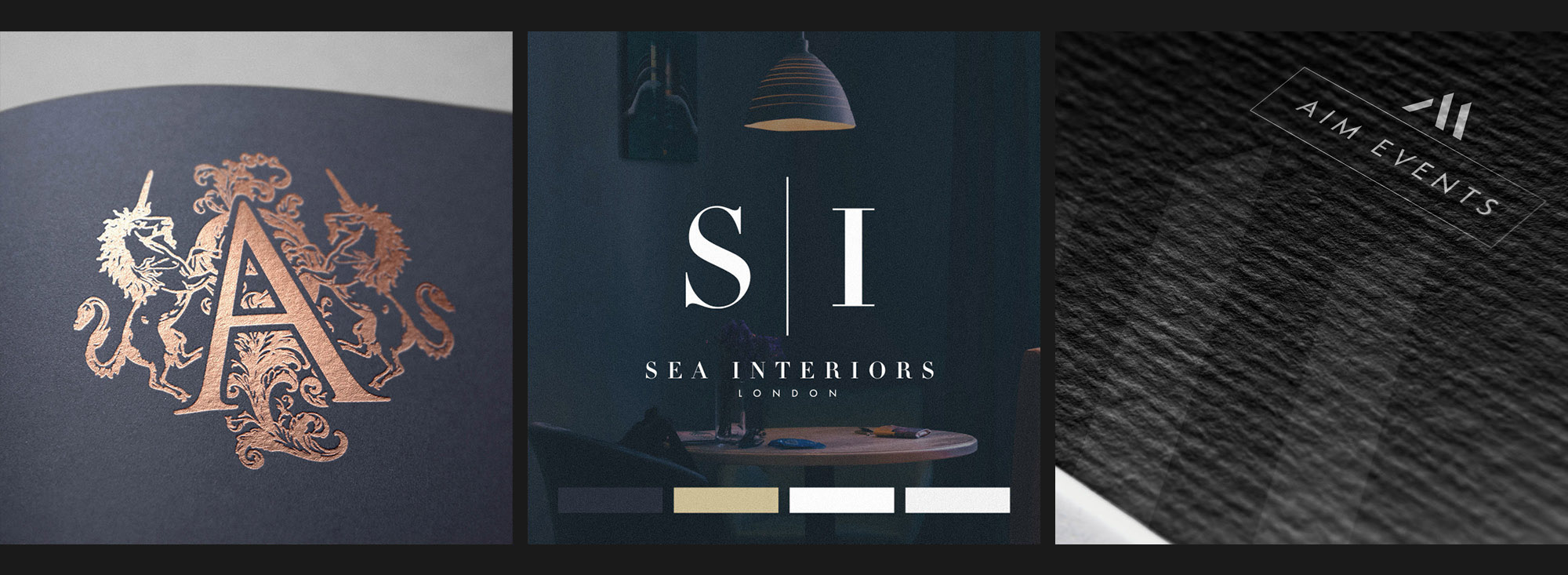
That restraint leaves more room for craft, not less. The pleasure of this work is in the detail: the weight of foil on uncoated stock, a monogram that holds together at fifteen millimetres as cleanly as it does at three metres, the perfect texture that provides depth without distraction. Those are the things people notice at a subconscious level, but which make a profound difference.
The aim is an identity that raises perceived value, while feeling tailored to a specific audience.
Do you use AI?
Definitely in some areas, and definitely not in others!
AI tools are excellent for research, coding, building components, creating mock-ups and sense-checking strategy. What they cannot replace is imagination, personality, experience and human craftsmanship, and that is the part I most enjoy. The results are beautifully human.
“Aesthetically striking, but disciplined. Indulgent, but not busy.”
Process
The detail varies by project, but the shape holds.
Research and discovery. Getting fully up to speed with the brand, its industry, its intended audience and its journey so far. Nothing useful can be decided before this.
Strategy and direction. Key insights from the research and competitor audit are presented, and we align on messaging, tone, positioning and audience. This is the brand consultancy half of the work, and on larger scopes it includes consumer profiles.
Design and development. Concepts begin with the logo, the cornerstone of any identity, working in shape and form before colour is introduced. The chosen route is then developed with colour, type, texture and pattern, and applied across whatever collateral the project needs.
Every identity is delivered with brand guidelines articulating the decisions made and the principles to follow, and with artwork supplied in every format you will need. What you are left with is a clear visual system, ready to extend into websites, packaging and anything that comes next.
Design Educator
Teaching and speaking
Alongside client work, (and when I can find the time!) I enjoy teaching design, through my YouTube channel and on Skillshare, with a combined 500,000 minutes watched across a range of courses.
Serving as an educator keeps me sharp on fundamentals and forces me to articulate decisions I might otherwise make on instinct. It’s also a rewarding way to give something back to an industry and community which has given me so much. I’ll always be grateful designers such as Alina Wheeler, Paula Scher, Michael Bierut, George Bakua – all took the time to publish books and/or courses for the benefit of designers to follow them.
Increasingly I find founders watching too, wanting to understand what actually happens behind the scenes before they commission it.