
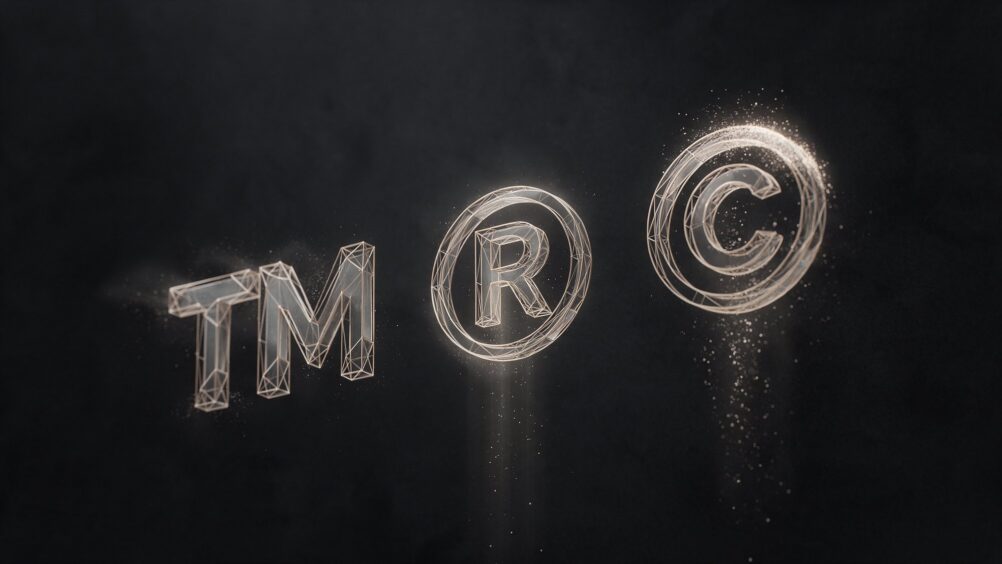
It’s one of the questions I’m asked most often at the end of a logo or brand identity project: “Should I trademark this?” The honest answer is that it depends on what your logo is worth to you, now and in a few years’ time. This guide explains what a trademark actually does, how it differs from copyright, what it costs in the UK, Europe and the US, and why AI-designed logos complicate things.
A quick note: I’m a designer, not a lawyer. This is a practical overview to help you ask the right questions. For advice on your own brand, speak to a trademark attorney.
What is a trademark?
A trademark is a sign that tells customers who a product or service comes from. It can be a name, a logo, a slogan, even a colour or a sound. Registering it with an official body, such as the UK Intellectual Property Office (UKIPO), the EU Intellectual Property Office (EUIPO) or the US Patent and Trademark Office (USPTO), gives you the exclusive right to use that mark for the goods and services you list.
Two details catch people out. First, a registration only covers the territory it was filed in, so a UK trademark gives you no rights in France or New York. Second, it only covers the classes you choose. There are 45 classes, from clothing (class 25) to restaurants (class 43), and two businesses can register near-identical marks in unrelated classes without conflict.
Trademark vs copyright: what’s the difference?
They protect different things, and a logo can have both.
Copyright
Protects an original creative work, such as the artwork of your logo, from being copied. In the UK it arises automatically when the work is created; there is nothing to file. Crucially, it belongs to the person who created it. When you commission a logo, the designer, studio or agency owns the copyright unless they assign it to you in writing. (I assign copyright to clients on completion and final payment, and it’s worth checking any designer you hire does the same.)
Trademark
Protects your logo as a badge of origin in the marketplace. A registered trademark lets you stop others using an identical or confusingly similar mark for similar goods or services, even if they drew it themselves and copied nothing.
In short, copyright stops people copying your artwork; a trademark stops people trading under something that could be mistaken for your brand.
The problem with AI-designed logos
Copyright depends on there being a human author, and that is where AI-generated logos run into trouble.
In the US, purely AI-generated images cannot be protected by copyright. The courts confirmed this in Thaler v. Perlmutter, and the Supreme Court declined to review the case in March 2026 (Mayer Brown). In the UK the position is less clear. Section 9(3) of the Copyright, Designs and Patents Act 1988 gives a form of protection to “computer-generated works”, but the government’s March 2026 report suggests that provision could be removed, with no timeline yet (Herbert Smith Freehills Kramer).
“How much are you prepared to invest in a logo you may not be able to prove you own?”
That’s the real question. Every year you spend building recognition around a logo adds to its value. If you can’t show you own the copyright, you may struggle to stop a competitor using something very close to it, and the more successful your brand becomes, the more that matters.
Can you trademark an AI-generated logo?
Yes. It’s a common misconception that you need to own the copyright to complete a trademark application. Trademark offices don’t ask who, or what, designed your logo. But an AI logo does carry particular risks:
It may look like someone else’s mark
AI tools generate images from patterns in existing work, and logos are often simple shapes. The result can sit uncomfortably close to a mark already registered, leading to an objection, an opposition from the owner, or a claim against you after you’ve launched.
It may not be distinctive enough
A mark must be distinctive to be registered. Generic, stock-feeling imagery (a leaf for a wellness brand, a house for an estate agent) can be refused, or registered with such narrow protection that it’s of little practical use.
Copying is harder to stop
Without copyright, your trademark becomes your main line of defence, and it only covers the classes and territories you’ve paid for. Someone could still reuse the artwork in a market you haven’t registered in.
If you’re weighing up AI for your brand, I’ve covered the pros and cons in more detail in Should you use AI to design your brand?

What a registered trademark does (and doesn’t) do
Registration gives you strong legal rights, but it isn’t a force field. Nobody polices the register on your behalf: if someone uses a similar mark, it’s up to you to spot it and act.
In practice, that usually starts with a cease and desist letter from a solicitor or trademark attorney, and can lead to court if the other party refuses. A registration makes that process far simpler, because you don’t have to prove your reputation; the certificate does much of the work. Many brands also pay for a watch service, which alerts them when a similar mark is filed so they can oppose it before it’s registered.
Who is responsible for registering the trademark?
Usually you, the business owner. The trademark should be filed in the name of the business (or person) that will own and trade under the brand, not the designer.
Some agencies include trademark checks within a larger branding scope, and a good designer will steer you away from obvious conflicts. But a designer’s check is not a legal clearance search. For anything you plan to invest in seriously, a trademark attorney can run a full search and handle the application, which reduces the chance of an objection or opposition.
It’s also worth planning the timing. Ideally, search before you commit to a name and logo, and file before you launch publicly.
How much does it cost to trademark a logo?
These are the official filing fees in 2026. Professional fees for a search and application are extra, typically a few hundred pounds upwards per territory.
United Kingdom (UKIPO)
£205 for one class, plus £60 per additional class
Online application fees rose from £170 and £50 on 1 April 2026 (Foot Anstey). Covers England, Scotland, Wales and Northern Ireland.
European Union (EUIPO)
€850 for one class, €50 for the second, €150 for each class after that
One application covers all EU member states (TMarkMetric). Note the UK is no longer included.
United States (USPTO)
$350 per class
The base fee since January 2025, with surcharges if information is missing ($100 per class) or if you describe your goods and services in your own words rather than choosing from the USPTO’s pre-approved list ($200 per class) (Reed Smith).
Other countries
The Madrid Protocol lets you extend a UK or EU application to many other countries through a single international application, paying a fee per country.
Because a registration is specific to both territory and class, you may need several. A skincare brand selling online in the UK and EU might file in class 3 (cosmetics) and class 35 (retail services) in both regions. UK, EU and US registrations all last 10 years and can be renewed indefinitely.
Do all brands need to register a trademark?
No. It depends on the size of your business, where you trade, and how much your logo is worth to you.
A small local or boutique business
Often fine to wait.
If you trade in one town and your customers know you personally, the risk of a damaging conflict is low, and the money may be better spent on the brand itself. Do run a basic search to make sure you aren’t infringing someone else.
A growing brand investing in recognition
Worth registering.
Once you’re spending on marketing, packaging, signage or a website, you’re building brand equity. Registering protects that investment and avoids a costly rebrand if someone else files first.
Selling online, nationally or abroad
Register early.
Marketplaces such as Amazon’s Brand Registry require a registered or pending trademark, and wider reach means more chance of a clash.
Raising investment or planning to sell
Register.
Investors and buyers will expect to see your key marks registered as part of due diligence.
If you’re still at the logo stage, you may also find How much should you pay for a logo design? useful.
Using ™ before you register
There’s no official “pending” symbol, but the ™ symbol does a similar job, and it’s free.
™ Trademark
Can be used by anyone, on any name or logo they claim as their trademark, whether registered, applied for, or not filed at all (Nelsons). There’s no time limit, so some brands use it for years until they’re ready to register. It puts others on notice that you claim the mark, but it gives no legal protection on its own.
® Registered trademark
Can only be used once your mark is registered, and only in the territories and for the goods and services it’s registered for. In the UK, using ® on an unregistered mark is a criminal offence under section 95 of the Trade Marks Act 1994. In the US, ® is reserved for marks on the federal register.
© Copyright
Marks a creative work as protected by copyright. It isn’t required in the UK or US, and it relates to the artwork, not your rights as a brand.
Without a registration, you aren’t completely unprotected. In the UK, the law of passing off can stop someone misrepresenting their business as yours, and the US offers similar “common law” rights. But you’ll need to prove you’ve built a reputation (goodwill) in that market, which is slower, harder and more expensive than relying on a registration.
“Use ™ while you grow. Register when your logo becomes worth protecting.”
Frequently asked questions
Do I need to trademark my logo?
Not always, and not straight away. Registration is worth it once you are investing seriously in your brand, trading under it widely, or operating in a crowded market. A small local business can often wait, using the TM symbol in the meantime.
Can I trademark an AI-generated logo?
Yes. Trademark offices do not ask who or what designed a logo. The risks are that an AI logo may resemble an existing mark and be refused or opposed, may not be distinctive enough, and may not be protected by copyright, which makes copying harder to stop.
What is the difference between TM and the registered symbol?
TM can be used by anyone to show they claim a name or logo as a trademark, registered or not. The registered symbol can only be used once the mark is registered. In the UK, using it on an unregistered mark is a criminal offence.
How much does it cost to trademark a logo?
Official fees from 2026 are around £205 in the UK for one class (£60 per extra class), €850 for an EU trade mark in one class, and $350 per class in the US. Attorney fees, searches and extra classes are on top.
Does copyright protect my logo?
Copyright can protect a logo as an original artistic work, but it belongs to the designer unless it is transferred to you in writing. Copyright stops copying; a registered trademark stops others using a confusingly similar mark in your market.
How long does a trademark last?
UK, EU and US registrations last 10 years and can be renewed indefinitely, as long as fees are paid and, in the US, the mark stays in use.