
If you have ever heard terms like value, premium, high-end or luxury used in branding conversations, you may have wondered what they actually mean in practice.
These words are often used casually, but they describe something very important: positioning.
Positioning is the place your brand occupies in the minds of your audience, especially in relation to competing alternatives. It shapes what people expect from your business in terms of quality, service, expertise, experience and price.
In simple terms, positioning answers questions like:
- Are you the affordable option, or the specialist option?
- Are you broad and accessible, or selective and elevated?
- Are clients buying based on price, reassurance, expertise, exclusivity, or a combination of these?
This matters because people are constantly reading signals.
A useful way to picture it is the supermarket shelf:

Products are often arranged in a way that makes their positioning immediately clear. At one end, you may find the most economical options, with simple packaging and lower prices. At the other, you’ll often see products presented as superior, refined or luxurious, supported by more considered design, stronger storytelling and a noticeably higher price point.
The same principle applies to professional service businesses.
Even though a client can’t physically pick up a service in the way they might pick up a bottle, box or packet, they are still making rapid judgements. Your branding, website, messaging, tone of voice, pricing and overall presentation all help them decide where your business sits in the market.
What positioning really means
Positioning is not simply about looking polished or expensive.
It is about defining how your business should be perceived relative to competitors, then ensuring every part of the brand supports that position.
That includes your:
- visual identity
- website
- photography and imagery
- tone of voice
- pricing
- offer structure
- client experience
- portfolio or case studies
- overall level of presentation
This is why positioning is such an important part of brand strategy.
A business cannot simply decide it wants to “look luxury” if its pricing, service level, process and offer do not support that claim. Equally, a genuinely exceptional business can easily undersell itself if its branding feels too generic, inconsistent or low-value for the level at which it actually operates.
Good branding should not create confusion. It should create clarity.
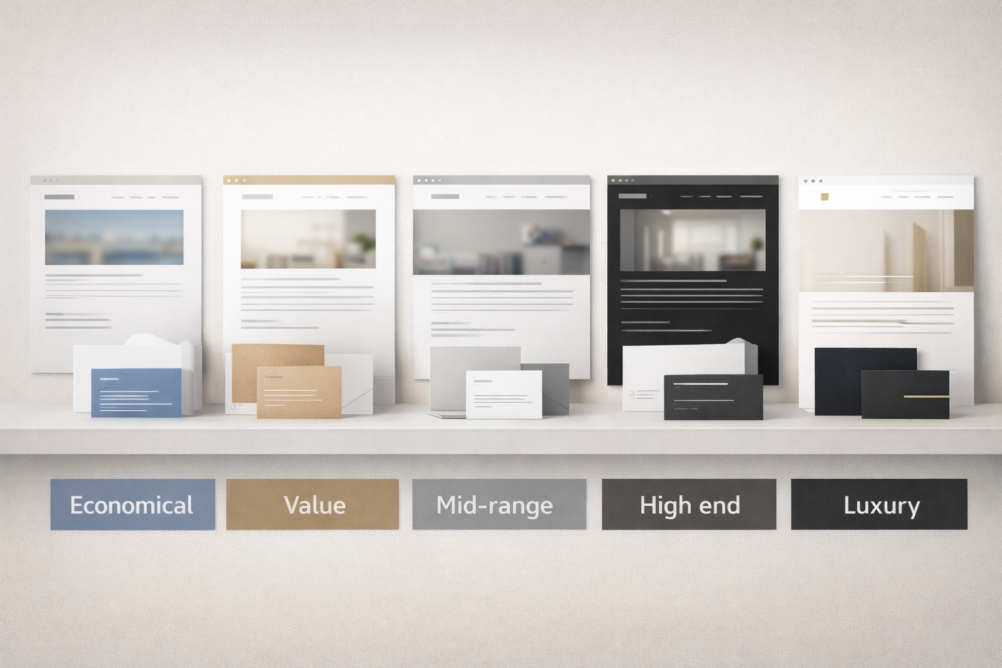
A simple positioning spectrum
Every business is different, but it can be helpful to think of positioning as a spectrum.
Economical
An economical brand is focused primarily on affordability. The goal is to feel accessible, practical and cost-effective.
The emphasis here is not on exclusivity or refinement for its own sake, but on delivering a functional solution at the lowest sensible price.
Typical signals might include straightforward messaging, minimal presentation, simple websites and a strong focus on cost or convenience.
A service-based example might be a no-frills bookkeeping service, a basic brochure website package, or a provider competing largely on price.
There is nothing inherently wrong with this position. It simply appeals to a different set of priorities.
Value
A value-positioned brand still cares about affordability, but places greater emphasis on trust, reliability and sensible quality.
The message is often: good quality for the money.
Rather than feeling cheap, it aims to feel worthwhile. It may not be the lowest-priced option, but it reassures customers that they are making a smart, balanced decision.
A value-led service business might position itself as dependable, honest, practical and well-priced. The branding is usually clean and approachable, but not especially exclusive or aspirational.
Mid-range
Mid-range brands sit in the broad middle of the market.
They aim to feel competent, professional and dependable, often appealing to a wide audience. They are neither bargain-basement nor especially premium-led.
This is where many established businesses naturally sit. They offer a solid level of quality and service, but without the stronger sense of specialism, refinement or exclusivity associated with the upper end of the market.
A mid-range professional service brand may have a polished website, clear messaging and a respectable client experience, but it is not necessarily trying to feel rare, elite or highly selective.
High-end
A high-end brand moves into more elevated territory.
Here, clients expect greater attention to detail, stronger expertise, a more refined experience and a more considered visual presentation. Pricing is higher, but so is the expectation of quality.
High-end brands often feel more specialist, more intentional and more discerning. They are usually not trying to appeal to everyone.
In professional services, this might apply to a boutique legal firm, a specialist advisory practice, an architect working on premium residential projects, or a design studio serving ambitious, quality-conscious clients.
The branding here should signal confidence, maturity and clarity. It should feel carefully composed rather than loud, gimmicky or trend-led.
Luxury
Luxury sits beyond simply being expensive.
A true luxury brand typically combines exceptional quality with exclusivity, rarity, emotional appeal and an elevated overall experience. It often offers something beyond function: status, symbolism, intimacy, craftsmanship, discretion or access.
Luxury is not just about adding gold to a logo or increasing prices.
It is about creating a world around the brand that feels unmistakably more rarefied and desirable. That world is communicated through design, language, materials, service, detail, pacing and restraint.
In service-based terms, this might include a private family office, an elite concierge service, a highly exclusive property advisory firm, or a boutique consultancy serving a very select clientele at a very high level.
Luxury branding tends to rely less on noise and more on control. It doesn’t need to shout.
Why this matters for professional service brands
For product brands, people can often judge value through ingredients, materials, construction or packaging.
For service businesses, much of that judgement happens before the service is ever purchased.
A potential client might discover your business through your website, LinkedIn profile, Instagram page, referral, proposal document or email communication. Before they ever speak to you, they are already forming an impression.
They may be asking themselves:
- Does this feel credible?
- Does this feel established?
- Does this feel specialist?
- Does this feel worth the fee?
- Does this feel like the level of business I want to hire?
That is where positioning becomes so important.
Your brand identity is not there simply to make things look attractive. It is there to send the right signals to the right people.
For high-end professional service brands in particular, those signals often include:
- restraint rather than clutter
- confidence rather than hype
- clarity rather than noise
- quality rather than gimmicks
- consistency rather than improvisation
- expertise rather than vague claims
Of course, the visual identity can help communicate these things, but it cannot do the job alone.
If the branding suggests a premium level of service, the offer itself must back that up. The pricing must make sense. The client experience must feel considered. The communication must be polished. The work must justify the promise.
Otherwise, the brand creates doubt instead of trust.
The danger of mismatch
One of the most common problems I see is a mismatch between where a business wants to sit and the signals it is currently sending.
For example:
- a genuinely excellent business with weak or dated branding may appear less capable than it really is
- a company trying to attract premium clients may still be communicating in a very mass-market way
- a brand that looks highly polished but is priced unusually low can accidentally create suspicion rather than demand
- a business describing itself as luxury, without the service model, exclusivity or detail to support that position, may feel inauthentic
This is why positioning should never be reduced to aesthetics.
The goal is not to create a brand that simply looks expensive. The goal is to create a brand that accurately communicates the level at which the business truly operates, or is strategically building towards.
How positioning influences brand identity
Once positioning is clearly defined, design decisions become far easier.
A brand positioned around value may need to feel approachable, clear and trustworthy.
A high-end brand may need to feel refined, editorial, specialist and quietly confident.
A luxury brand may need to feel more exclusive, more rarefied and more emotionally charged, often with a greater sense of restraint and detail.
This affects everything from typography and colour palette to photography style, layout, website structure and tone of voice.
It also affects what should be avoided.
A high-end advisory firm, for example, may not want branding that feels too playful, cluttered or trend-driven. A value-focused business may not want branding so minimal and abstract that it becomes cold, confusing or inaccessible.
The right answer depends on the intended market position, the target audience and the competitive landscape.
That is exactly why this belongs within brand strategy, not just surface-level design.
Final thoughts
Positioning is one of the most important foundations of an effective brand.
It helps define how your business should be perceived, what expectations it should create, and what kind of client it is most likely to attract.
Whether a brand is economical, value-led, mid-range, high-end or luxury, the goal is not to chase a label for the sake of it. The goal is to be clear, credible and aligned.
When the positioning is right, the branding feels coherent.
The messaging makes sense.
The pricing feels believable.
And the business attracts people who are a better fit.
When that strategic groundwork is done properly, the visual identity has something meaningful to express.
This is a crucial part of the brand strategy process I help clients navigate before we move into design. Because the most effective identities do not just look good — they communicate the right level of value to the right audience, with clarity and confidence.
Author – Jason Miller, Brand Identity Designer – jmgraphicdesign.com